Guide
How Do You Make a Saskatoon Yard Low Maintenance?
Low-maintenance and xeriscape landscaping for Saskatoon — drought-tolerant prairie planting, reduced lawn, and what actually cuts the work.
This guide covers low-maintenance landscaping for Saskatoon properties, including xeriscaping — designing a yard that needs little or no supplemental water. Saskatoon receives around 357 mm of precipitation a year with a reliably dry July, which makes drought-tolerant design a natural fit here rather than a compromise. It is written for homeowners who want a yard that looks after itself, whether for time, cost, or because they are not always around.
What Actually Reduces Yard Maintenance?
Reducing lawn area is the single largest reduction available, and it is not close. Turf is the highest-maintenance surface in any Saskatoon yard — it is mown weekly, watered through July, fed, aerated, and treated for weeds. Every square metre converted to a mulched bed of hardy shrubs removes all of that permanently.
Choosing plants that fit their space is the second. A shrub that reaches its mature size within the room available needs nothing; the same bed planted with something that outgrows the space needs cutting back every year forever. Most "high-maintenance" beds are simply the wrong plant in the wrong place.
Mulching properly is the third and the cheapest. A good depth of mulch suppresses weeds, holds moisture in soil that dries fast, and moderates the soil temperature swings that are hard on plants here. Thin or absent mulch is why some beds need weeding every week and others do not.
What Is Xeriscaping and Does It Work in Saskatoon?
Xeriscaping means designing a landscape to need little or no water beyond what falls on it. It works particularly well in Saskatoon, where annual precipitation is modest, July is reliably dry, and unwatered lawns go dormant and brown most summers anyway.
It is not a gravel yard with three plants, which is the common misconception and produces a hot, stark result nobody enjoys. Done properly it is dense, layered planting of drought-tolerant species — the difference is what is planted and how the soil is prepared, not how much is planted.
The practical method is to group plants by water need, improve the soil so it holds what moisture it gets, mulch heavily, and keep any turf area small and in one place where it can be watered efficiently. A xeriscaped Saskatoon yard still gets watered in its first season while it establishes; the point is that it does not need watering afterwards.
What Are the Best Drought-Tolerant Plants for Saskatchewan?
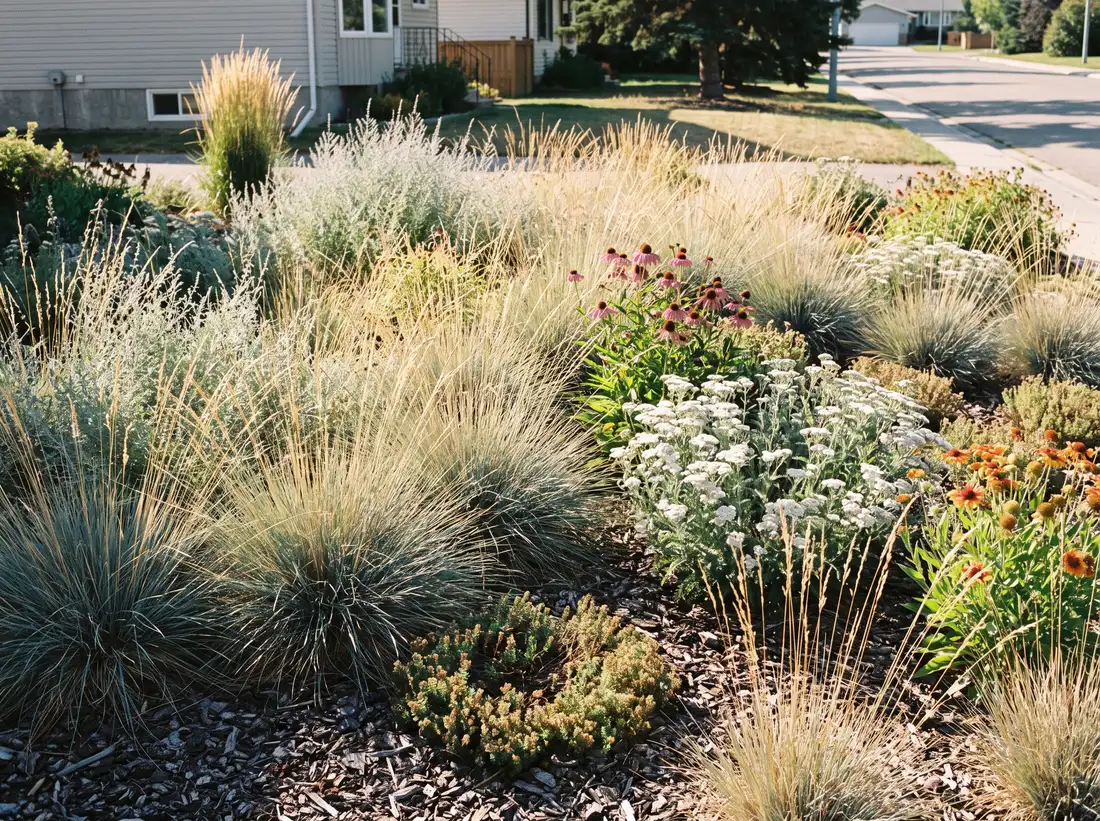
Native and prairie-adapted species are the obvious starting point, since they evolved in exactly these conditions. Native grasses such as little bluestem and blue grama handle drought and wind, hold their form through winter, and need nothing.
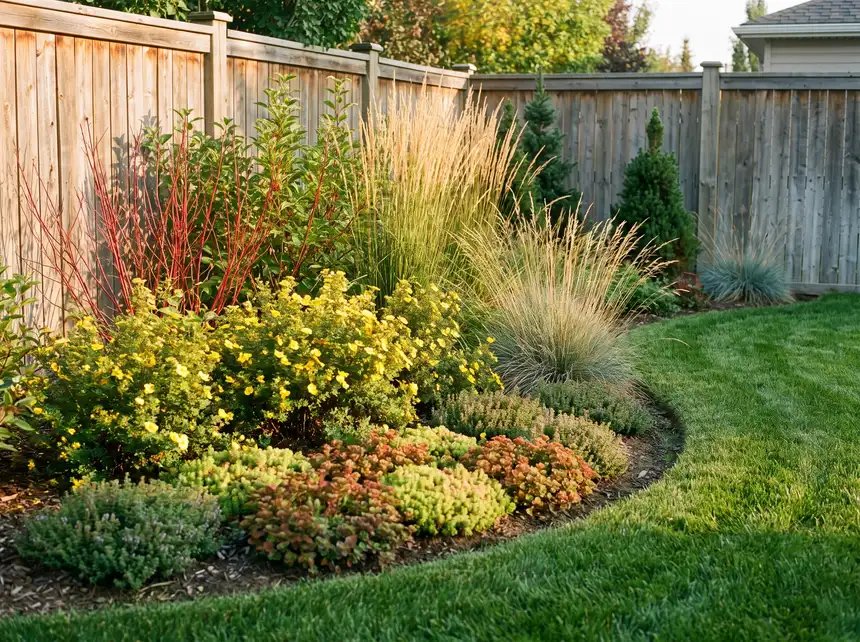
For shrubs, potentilla, buffaloberry, sea buckthorn, and juniper are all genuinely drought-tolerant once established and reliably hardy in zone 3a. For perennials, sedum, yarrow, blanket flower, and prairie coneflower survive a dry Saskatoon July without irrigation.
The phrase to keep in mind is "once established". Every drought-tolerant planting needs consistent water through its first season while it puts down the root system that later makes it independent. Skipping that first year is the most common reason a xeriscape planting fails.
What Low-Maintenance Choices Backfire in Saskatoon?
Landscape fabric under mulch is the classic one. It works for a couple of years and then organic matter accumulates on top of it, weeds root in that layer, and the fabric prevents you from getting at them properly while also stopping mulch from improving the soil beneath. Most established beds are better without it.
Rock mulch in full sun is the second. It never breaks down, which sounds like an advantage, but it radiates heat onto the plants around it, makes leaf litter almost impossible to clean out, and cannot easily be removed once you change your mind. In a hot south-facing Saskatoon bed it can be actively hostile to the plants it surrounds.
Artificial turf across a whole yard is the third, and it is worth being clear about the trade-off. It genuinely eliminates lawn maintenance and is excellent for a dog run or a shaded strip, but a full yard of it gets uncomfortably hot in July sun and it is a significant up-front cost to solve a problem that reducing lawn area often solves more cheaply.
Where Does This Fit With the Rest of the Yard?
A low-maintenance yard is rarely the only thing a property needs, and the order the work happens in matters more on Saskatoon clay than most people expect. Ground comes first: if water is pooling or running toward the house, grading and drainage is the job to do before anything you can see. Buried services like irrigation go in before surfaces, and sod goes down after the hard landscaping rather than before it.
The jobs most often quoted alongside this one are landscape design, artificial turf and irrigation & sprinklers. Doing them in one visit is usually cheaper than bringing equipment back, because the mobilisation and the machine access are paid for once.
If you are planning the whole property rather than one job, start with a landscape design so the phases are sequenced before anything is built. Otherwise, the full service list covers everything we do, the cost guides explain what drives each price here, and the how-to guides are written for Saskatchewan timing rather than the milder-climate advice most search results give you. We work across Saskatoon and the surrounding area, including Warman, and every quote is free and given on site.
Want a number for your own property?
Tell us what you need and where the property is. We come out, look at the ground, and give you a written scope and price — no charge and no obligation.
- Free on-site quotes across Saskatoon
- Prairie-hardy plantings that survive zone 3a winters
- Utility locates arranged before any digging
- Summer yard work and winter snow from one contractor
- Written scope before a shovel goes in the ground
Frequently Asked Questions
What is xeriscaping?
Designing a landscape so it needs little or no supplemental water — through drought-tolerant plant selection, soil preparation that holds moisture, heavy mulching, and grouping plants by water need. It suits Saskatoon well, where annual precipitation is around 357 mm and July is reliably dry.
What are the best drought-tolerant plants for Saskatchewan?
Native grasses like little bluestem and blue grama; shrubs including potentilla, buffaloberry, sea buckthorn, and juniper; and perennials such as sedum, yarrow, blanket flower, and prairie coneflower. All are hardy to zone 3a and need no watering once established.
Does a low-maintenance yard mean no maintenance?
No. It means a few hours a season instead of a few hours a week. Beds still need occasional weeding, mulch needs topping up every few years, and shrubs need pruning occasionally. The saving comes from eliminating the weekly work rather than all work.
Should I use landscape fabric under mulch?
Usually not in a planted bed. It helps for a season or two, then organic matter builds on top of it, weeds root in that layer, and the fabric makes them harder to remove while blocking mulch from improving the soil. It is more defensible under gravel paths than under planting.
Is rock mulch better than wood mulch?
It lasts longer and never needs topping up, which is its advantage. Against that, it radiates heat onto surrounding plants, traps leaf litter that is difficult to clean out, does nothing for the soil, and is genuinely hard to remove later. In a hot south-facing Saskatoon bed, wood mulch is usually kinder to the plants.
How much can I reduce my water use with xeriscaping?
Substantially, because lawn is what consumes almost all residential irrigation water. A yard with a small turf area and the rest in established drought-tolerant planting needs very little supplemental watering in a normal Saskatoon summer, and none at all in a wet one.
Do drought-tolerant plants need watering at first?
Yes, consistently through their first season while they establish the root system that later makes them independent. Skipping this is the most common reason a xeriscape planting fails — the plants are drought-tolerant once established, not on the day they go in.
Can I convert my existing lawn to low-maintenance beds?
Yes, and it is straightforward work. The turf is removed, the soil improved, planting installed, and the whole area mulched. Doing it in stages is perfectly reasonable, and starting with the areas of lawn that struggle most — deep shade, dry strips, awkward corners — gives the best return first.
Services this covers
The work behind this guide, quoted on site and in writing.
Year-round (design); May–October (build)
Landscape Design
Full yard plans with prairie-hardy planting, built around how you actually use the space.
See what it involves→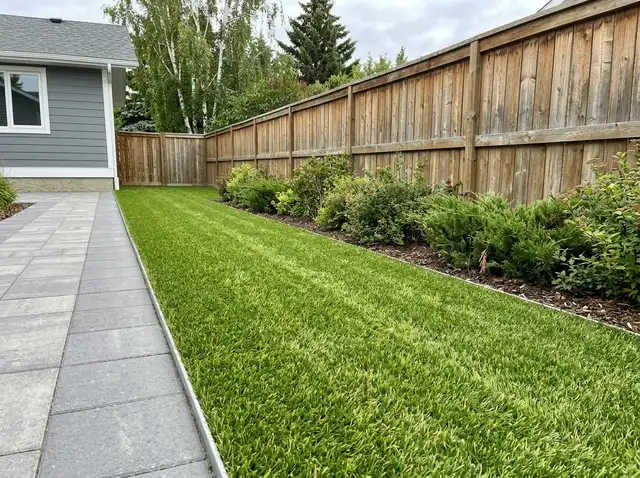
Artificial Turf
Synthetic turf for pet runs, play areas, and yards where real grass has stopped working.
May through October
Irrigation & Sprinklers
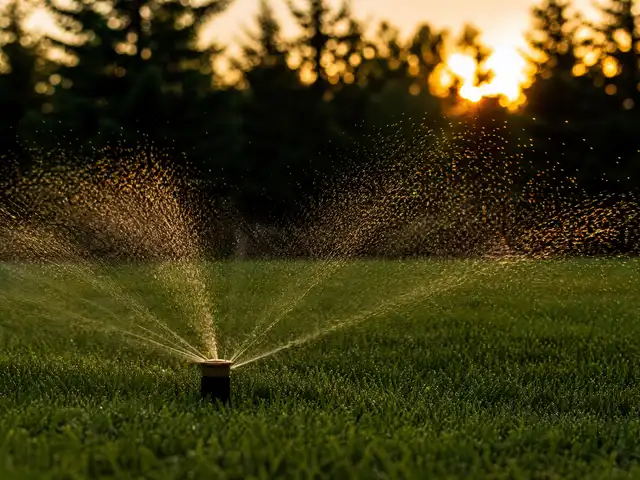
Sprinkler system design, installation, spring startups, and fall blowouts.
May through October
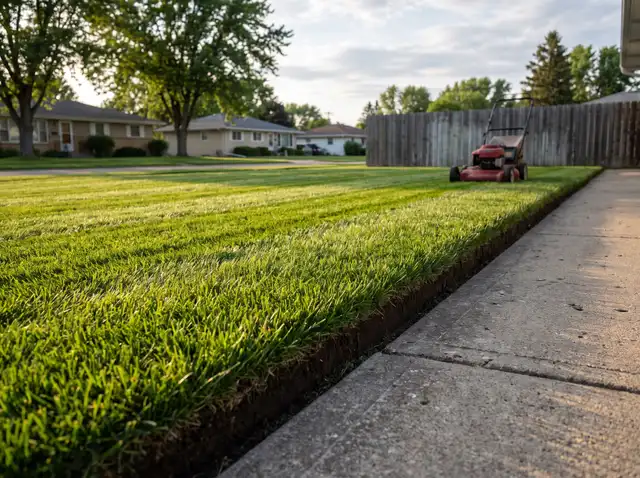
Lawn Care
Weekly mowing, trimming, and seasonal lawn maintenance across Saskatoon and area.
May through September
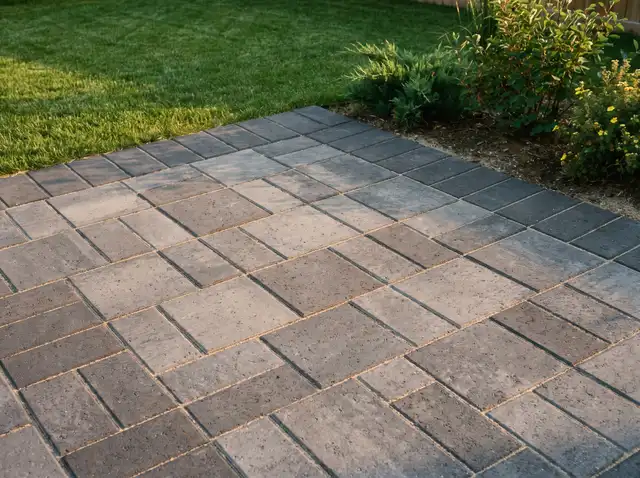
Paving Stones & Patios
Paving stone patios, walkways, and driveways built on a base that handles prairie frost.
May through October