Guide
How Do You Fix a Dead or Dying Lawn?
How to tell whether a brown Saskatoon lawn is dead or dormant, what actually revives it, and when replacement is the cheaper answer.
This guide helps you work out whether a brown, thin, or patchy Saskatoon lawn is actually dead or merely dormant, and what to do in each case. Prairie lawns brown off routinely in a dry July and recover on their own, so a great deal of money gets spent reviving grass that was never dying. It is written for homeowners looking at a lawn that has gone backwards and trying to decide between repair and replacement.
Is Your Lawn Dead or Just Dormant?
Kentucky bluegrass — which is virtually every Saskatoon lawn — goes dormant in drought as a survival strategy. It browns off, stops growing, and looks dead, and then greens up within a couple of weeks once moisture returns. A uniformly brown lawn in a dry July is very often dormant rather than dead.
The tug test tells you which. Grip a handful of brown grass and pull. Dormant grass resists, because its roots and crown are alive and holding. Dead grass lifts away with no resistance at all, bringing no soil with it.
Pattern is the other clue. Dormancy is usually uniform across an area, since the whole lawn experiences the same drought. Dead patches are irregular — a circle here, a strip along the driveway, a run under a downspout — and irregular patterns mean a specific cause worth identifying.
What Kills Patches of Grass in a Saskatoon Lawn?
Snow mould is the classic spring finding: grey or pink matted patches that appear at melt, caused by grass going into winter long or buried under leaves. It usually recovers once raked open to dry, though badly affected patches need overseeding.
Dog urine produces small dead circles with a ring of dark green around the edge, and it is the most commonly misdiagnosed lawn problem. Salt and ice-melt damage produces a strip of dead grass along a driveway, walk, or the boulevard edge, and in Saskatoon it shows up in April along every route that was salted.
Then the structural causes: grubs, which leave turf that lifts like a carpet because the roots have been eaten; buried construction debris, which leaves a patch that dries out faster than everything around it; and simple compaction, which produces thin, hard, permanently struggling areas along walking routes.
How Do You Repair a Lawn That Is Genuinely Damaged?
Deal with the cause first. Reseeding a patch killed by salt without redirecting where the salt goes, or by a downspout without moving the downspout, produces a patch that dies again next year. This is the step people skip.
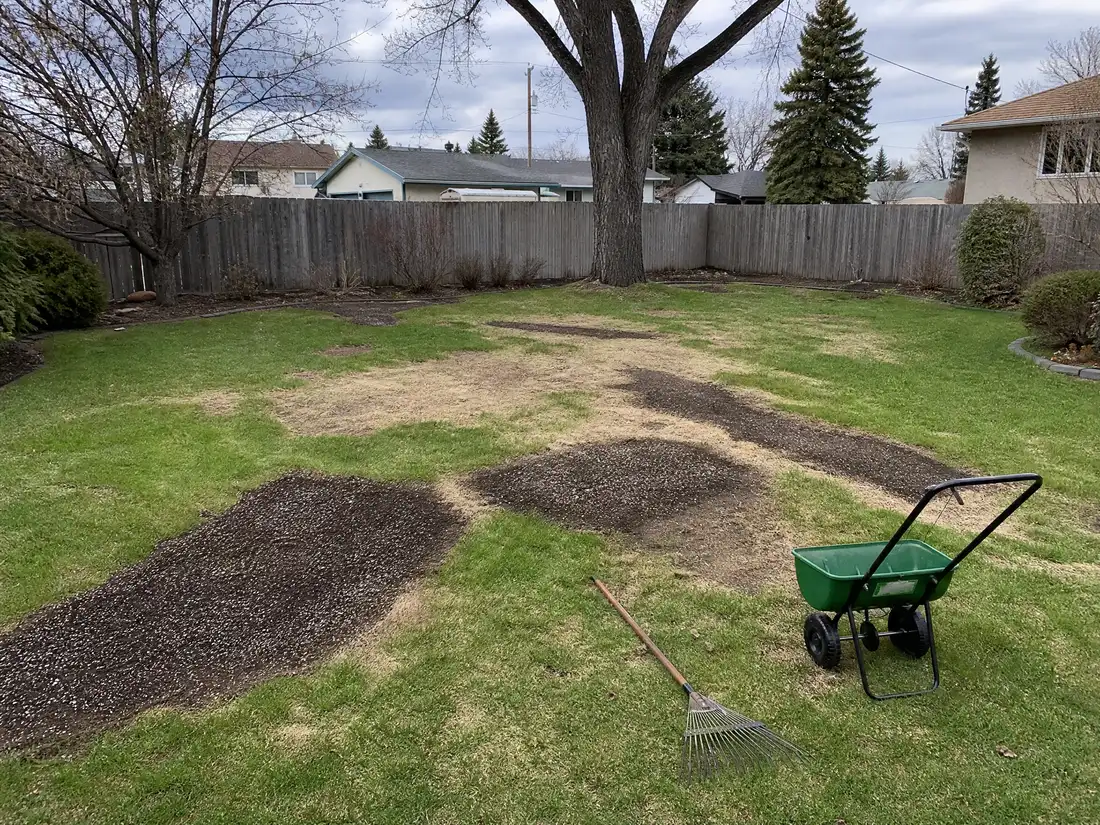
Then repair. Rake out the dead material, loosen the surface — particularly important on compacted Saskatoon clay, where seed onto a hard surface simply washes away — add a thin layer of soil mix, seed or patch with sod, and keep it consistently moist through establishment.
Time it to the season. Late August into September is by far the best window for lawn repair in Saskatchewan, because the new grass establishes in cool, moist conditions rather than fighting a dry July. Repairs made in midsummer frequently fail for reasons that have nothing to do with technique.
When Is It Cheaper to Replace the Lawn Than Repair It?
Repair when the damage is patchy and the rest of the lawn is healthy. Overseeding, aeration, and spot patching are far cheaper than a new lawn, and a lawn that is seventy percent good is worth saving.
Replace when more than about half the area is weed rather than grass, or when the turf is thin and struggling everywhere despite a season of correct care. At that point continuing to treat it costs more over two years than sod would.
The deciding question is usually what is underneath. A lawn failing because of compacted subsoil and insufficient topsoil will keep failing no matter how it is treated from the surface, and the honest recommendation is to strip it, fix the grade and the soil depth, and start again — because that is the only version of the work that lasts.
Where Does This Fit With the Rest of the Yard?
Bringing a dead lawn back is rarely the only thing a property needs, and the order the work happens in matters more on Saskatoon clay than most people expect. Ground comes first: if water is pooling or running toward the house, grading and drainage is the job to do before anything you can see. Buried services like irrigation go in before surfaces, and sod goes down after the hard landscaping rather than before it.
The jobs most often quoted alongside this one are sod installation, lawn aeration and weed control & fertilizing. Doing them in one visit is usually cheaper than bringing equipment back, because the mobilisation and the machine access are paid for once.
If you are planning the whole property rather than one job, start with a landscape design so the phases are sequenced before anything is built. Otherwise, the full service list covers everything we do, the cost guides explain what drives each price here, and the how-to guides are written for Saskatchewan timing rather than the milder-climate advice most search results give you. We work across Saskatoon and the surrounding area, including Warman, and every quote is free and given on site.
Want a number for your own property?
Tell us what you need and where the property is. We come out, look at the ground, and give you a written scope and price — no charge and no obligation.
- Free on-site quotes across Saskatoon
- Prairie-hardy plantings that survive zone 3a winters
- Utility locates arranged before any digging
- Summer yard work and winter snow from one contractor
- Written scope before a shovel goes in the ground
Frequently Asked Questions
How do I know if my lawn is dead or dormant?
Pull a handful of the brown grass. Dormant grass resists because the crown and roots are alive; dead grass lifts away with no resistance. Uniform browning across a whole lawn in a dry July is usually dormancy, while irregular patches usually mean something specific killed them.
Will a brown lawn come back on its own?
A dormant one will, within a couple of weeks of decent moisture returning. Bluegrass is built for this and a Saskatoon lawn can spend several weeks brown in July and be fine. A dead lawn will not recover and needs reseeding or replacing.
What causes grey matted patches in spring?
Snow mould, which develops under snow on grass that went into winter long or covered in leaves. It generally recovers once raked open to dry out, and badly affected areas can be overseeded. Cutting shorter for the final mow and clearing leaves before snow is what prevents it.
How do I fix dog urine spots?
Water the spot heavily to dilute the salts, then rake out the dead grass, add a little soil mix, and reseed. The dark green ring around the dead centre is the same nitrogen at a lower concentration — it is fertilizing there and burning in the middle.
Why is the grass along my driveway dead every spring?
Almost certainly salt or ice melt from winter. It accumulates in the soil along the edge and kills the grass at melt. Flush the strip thoroughly in spring, repair it, and switch to sand or a less aggressive ice-control product near landscaping.
When is the best time to repair a lawn in Saskatoon?
Late August into September. New grass establishes in cool, moist conditions instead of fighting a dry July, and it has time to root before freeze-up. Repairs attempted in midsummer often fail for reasons unrelated to how well the work was done.
Can I just throw seed on the bare patches?
It rarely works on Saskatoon clay. Seed on a hard surface washes away or dries out before germinating. Rake out the dead material, loosen the surface, add a thin layer of soil mix, then seed and keep it moist — that is what makes the difference.
How long does a damaged lawn take to recover?
Overseeded areas show germination in one to three weeks and blend in over a season. A lawn recovering from compaction takes a full year of aeration, feeding, and correct mowing to genuinely change. If there has been no visible improvement after a full season of proper care, the problem is likely the soil underneath rather than the grass.
Services this covers
The work behind this guide, quoted on site and in writing.
Late May through September
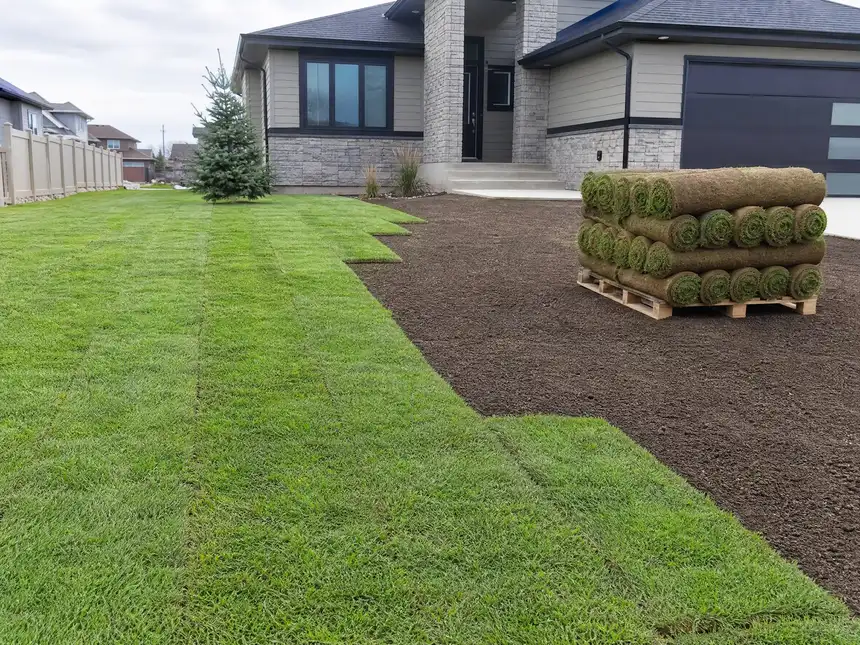
Sod Installation
New sod lawns on properly prepared grade and real topsoil depth, not laid over builder clay.
See what it involves→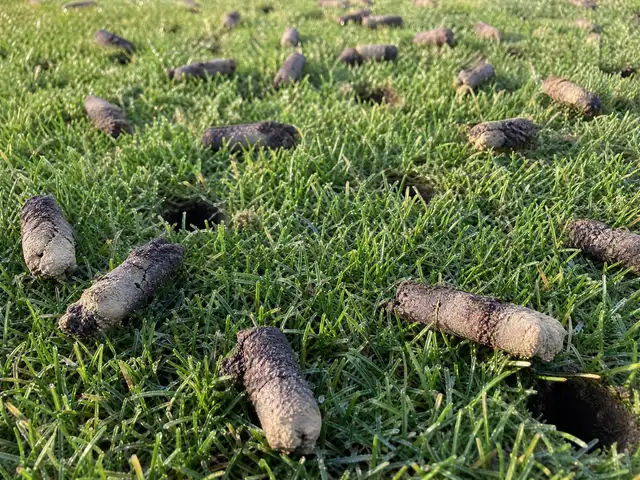
Lawn Aeration
Core aeration that opens up Saskatoon clay so water, air, and roots can get down.
May and September
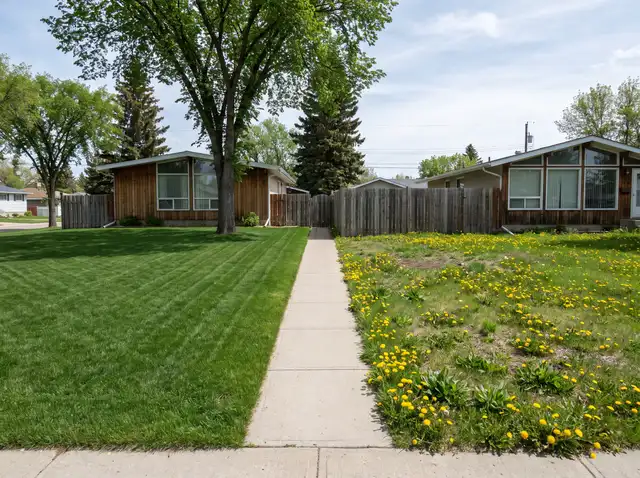
Weed Control & Fertilizing
Scheduled weed control and fertilizer programs built around the Saskatchewan season.
May through September
Lawn Care
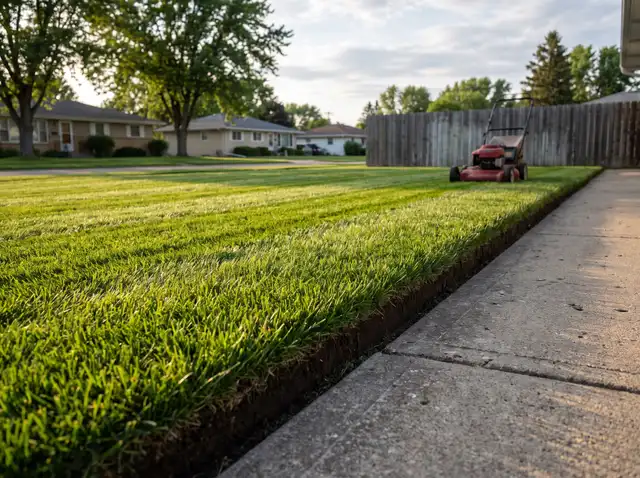
Weekly mowing, trimming, and seasonal lawn maintenance across Saskatoon and area.
May through September
Excavation, Grading & Earthworks
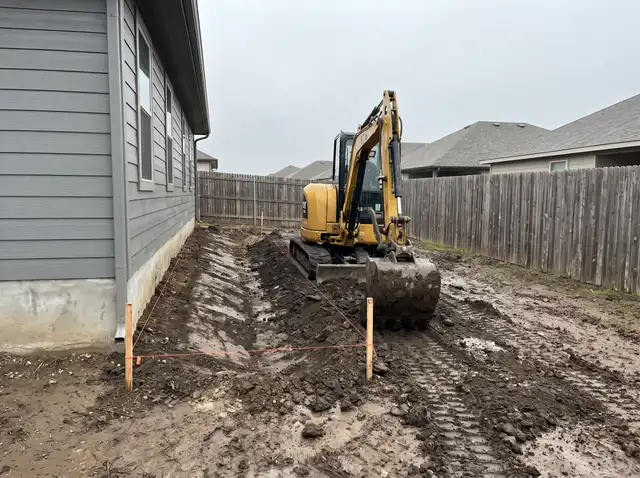
Yard grading, earthworks and drainage correction that moves water away from your foundation.
May through October